Skip to main content
Understanding the Role of Occupational Therapists with children
Helping children Thrive: The Power of Occupational Therapy
- Occupational therapists (OTs) are often thought of as working only on therapy sessions with children, but their expertise actually extends into many different areas of life.
- Occupational therapists don’t just provide therapy, they bridge the gap between challenges and opportunities. By working across home, school, community, and personal development, OTs empower children to thrive in every aspect of life.
- Occupational therapists collaborate with different professionals, such as teachers, speech therapist (ST), physiotherapists (PT) and psychologists, to take a holistic approach to treatment. This collaboration helps the occupational therapists to understand the children’s needs in different settings and improve the quality of care, resulting in better therapy outcomes and faster progress.
- Beyond traditional therapy areas like motor skills and sensory processing, occupational therapists are increasingly working in non-traditional, innovative fields with children such as mental health, community programmes, technology use, environmental design, and advocacy. These areas expand OT’s role from clinical care into broader social participation and wellbeing.
Occupational Therapists’ (OTs’) role:
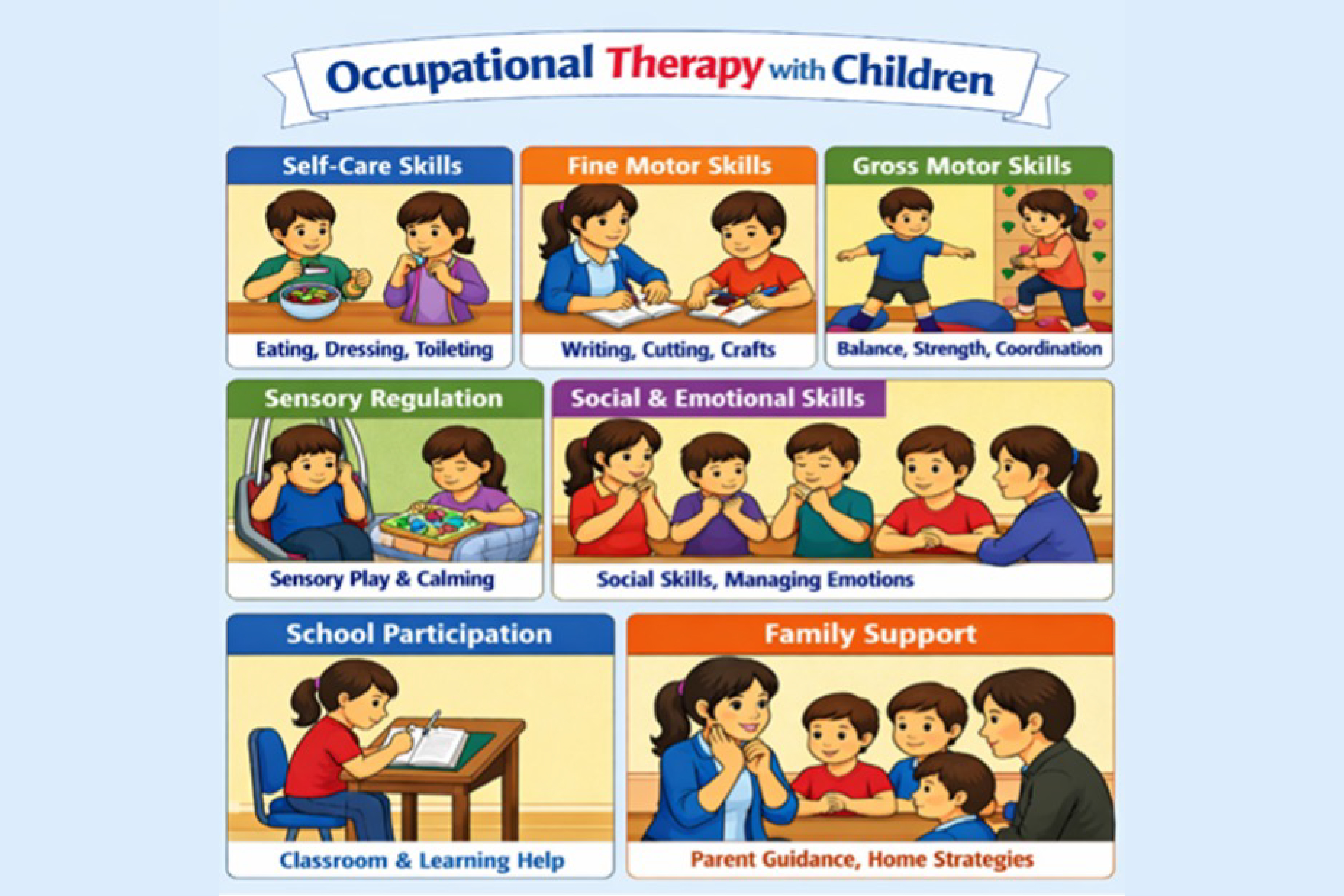
- Fine Motor Skills: OTs help children strengthen the small muscles in their hands and fingers, improving dexterity and coordination. This is essential for handwriting, drawing, or cutting with scissors; buttoning clothes, tying shoelaces, or using utensils and activities like threading to refine eye-hand coordination.
- Gross Motor Skills: OTs support large muscle movements essential for mobility, balance, and overall body coordination. This helps to improving posture and movement so children can join in playground games, navigate their environment safely and participate fully in school.
- Sensory Integration: Helping children to integrate their sensory functions like auditory, visual, proprioceptive (Body Awareness), vestibular (Balance and Movement) and tactile sensory system is another focus area of OT intervention. This helps children to regulate responses to sound, touch, or movement etc.
- Activities of Daily Living (ADLs): OTs teach and adapt everyday routines so children can manage self‑care and life skills independently, for example, dressing, grooming and feeding; organising school material and managing transitions between tasks. Building independence towards making routines for daily tasks and guiding parents on how to support skill practice at home is under the OTs’ remit.
- Home & Environment: OTs assess living spaces and recommend changes like ramps, grab bars, or adaptive furniture to make environments safer and more accessible. In school settings, they collaborate with teachers to adapt classrooms adjusting seating, lighting, or sensory corners to support learning. In the community setting, OTs help families plan for safe participation in playgrounds, public transport, and recreational activities.
- Splints & Assistive Devices: OTs make custom splints, designed to stabilise joints, improve hand function, and prevent deformities in children with physical challenges. OTs recommend (adaptive tools) utensils, writing aids, or dressing tools that make daily tasks easier. They also integrateapps or devices that support communication, organization, and independence.
- Emotional & Social Development: OTs builds confidence by helping children master small skills that boost self‑esteem. They also help in supporting inclusion in group play, classroom activities, and peer interactions. OTs also teach coping strategies to manage frustration, anxiety, or sensory overload.